
In a classic cycling race, climbers can beat sprinters up the hills, rouleurs can beat the climbers on the flat and sprinters can beat rouleurs in a bunch sprint.
Climbers > Sprinters: Hills (gravity favours low mass).
Rouleurs > Climbers: The flat (raw wattage and aero favour the powerhouse).
Sprinters > Rouleurs: The finish line (explosive twitch muscle).
The teams play a kind of Rock Paper Scissors game. Limits on budgets and the number of riders make it hard for a directeur sportif (DS) to have strong riders in all three categories, so teams tend to focus on two of the three specialties. In preparing to face competing teams at events, each DS needs to determine which category of rider should go for the win. A bit of game theory could be useful.
Rock Paper Scissors Minus One
A post on Mind Your Decisions describes an interesting variant on the classic Rock Paper Scissors game that featured in the Korean TV series Squid Game. In Rock Paper Scissors Minus One, players use both hands and then, at the call of “Minus One” they simultaneously withdraw one hand, with the remaining choices determining the outcome. The question is what is the optimal strategy?
The post explains that it is a bad idea to choose the same for both hands, because, if your opponent picks two options, the chances are that one of them will beat you. Therefore both players should pick two out of Rock Paper Scissors. This means there are only three combinations you should play in the first part of the game: (Rock Paper), (Paper Scissors) or (Scissors Rock). As a consequence, you will match your opponent one third of the time, resulting in a draw at “Minus One”, as long as you both sensibly select the stronger of your two options: if you both play, Rock Paper, you should both keep Paper.
The game becomes more interesting when your choices are different. In this case there will always be one choice in common. For example, if you play (Paper, Scissors) and your opponent plays (Paper, Rock), you both have Paper, but the question is which should you keep? The Korean video argues that it makes sense for you always to play Paper, because you cannot lose, whatever your opponent chooses. This forces your opponent to play Paper. But that makes it tempting for you to play Scissors, from time to time, in order to win. But that invites your opponent to play Rock occasionally, in defence.
Squid Game Theory
The Mind Your Decisions post goes on to explain that you need to consider the payoff for each player. By applying game theory, it is possible to arrive at a so-called Nash Equilibrium with both players adopting a mixed strategy, where they randomly choose which hand to play, with well defined probabilities.
In fact, if both players evaluate a win to be worth +1, a draw zero and a loss -1, it turns out that the optimal strategy is to play the hand you have in common 2/3 of the time and randomly choose the other hand 1/3 of the time.
So if the optimal strategy is to deviate 1/3 of the time, why did the Korean video argue that you should always play Paper? The two different answers can be reconciled by noting that the losers in the dramatisation of Squid Game are executed! The cost of a loss is so high that there is no reason for a rational person to take even the smallest risk a loss. As the negative consequences of a loss increase, the optimal probability of deviating from the hand you have in common falls from 1/3 to zero.
Back to the bike race
I asked Google Gemini to categorise the riders in the 18 UCI World Tour teams as either climbers, sprinters or rouleurs. Most teams have around 13 rouleurs in their rosters of 30 riders. The teams differentiate themselves in the split between climbers and sprinters. The teams going for the grand tours recruit climbers over sprinters, whereas those going for the classics prefer sprinters.
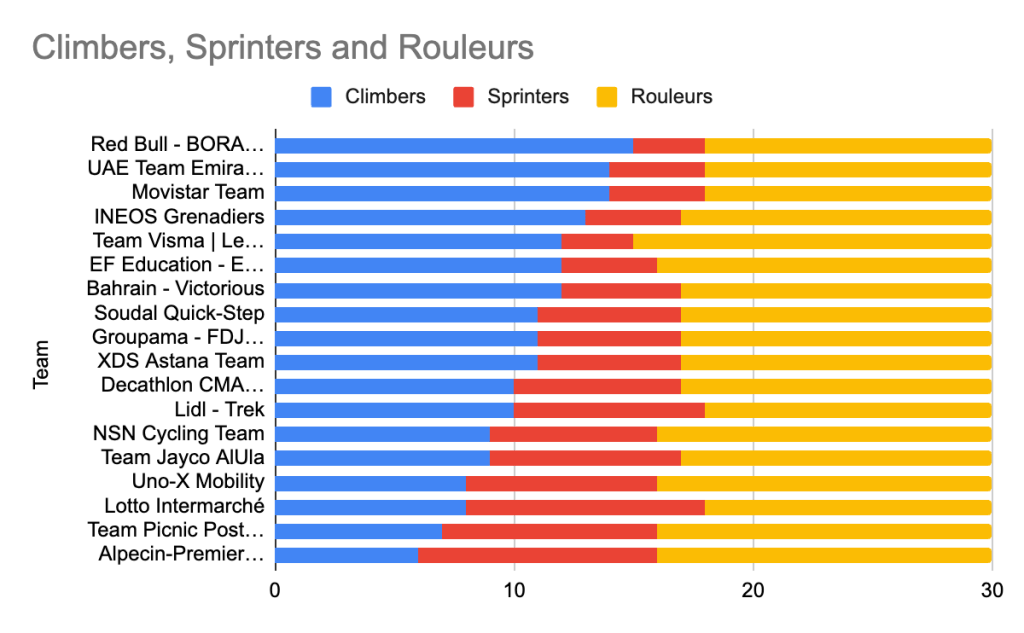
Teams like Red Bull – BORA, UAE and Movistar are likely to turn up at a race with a team of climbers and rouleurs (they play CR ), whereas the Lotto, Picnic PostNL and Alpecin teams tend to have sprinters and rouleurs (they play SR). The DS on each team must decide who to back for the win and which riders to burn out as domestiques. Ultimately the winner of the race will be in one category or the other, while everyone else is a loser. Can game theory shed some light on the optimal strategy?
On the face of it, we have a situation a bit like the Rock Paper Scissors Minus One game. Perhaps the optimal approach is a mixed strategy for both teams: they should both play R most of the time, but occasionally play either C or S. We might see this play out as a battle between the rouleurs of both teams, with either a climber or a sprinter occasionally attempting to join the breakaway.
Obviously the profile of the course plays an important role, but for simplicity let’s assume there are hills and flat sections with sprint finish, so everyone has a chance. Looking back at the compositions of the teams, every squad is likely to include some rouleurs alongside either sprinters or climbers. This is a bit like playing two-handed rock paper scissors where everyone plays either rock and paper or rock and scissors.
The nature of cycle racing creates a subtle asymmetry: the rouleur teammates of the sprinters should try to drop the climbers by riding as aggressively as possible on the flatter open sections, but drop the pace on the climbs; whereas the rouleur teammates of the climbers should do the opposite, in order to drop the sprinters.
Unlike Squid Game, where players should avoid a loss at all costs, bike racing rewards victory in prestigious race with high accolades. While the rouleurs in the peloton try to ensure a predictable showdown in a sprint or on a hilltop finish, game theory suggests it is worth trying a more risky strategy. This is exactly how Anna Kiesenhofer secured Olympic Gold in 2020. By attacking early and staying away, she effectively withdrew the hand the favourites expected her to play, leaving the world’s best sprinters and climbers bemused in a cloud of ink.
 Science4Performance